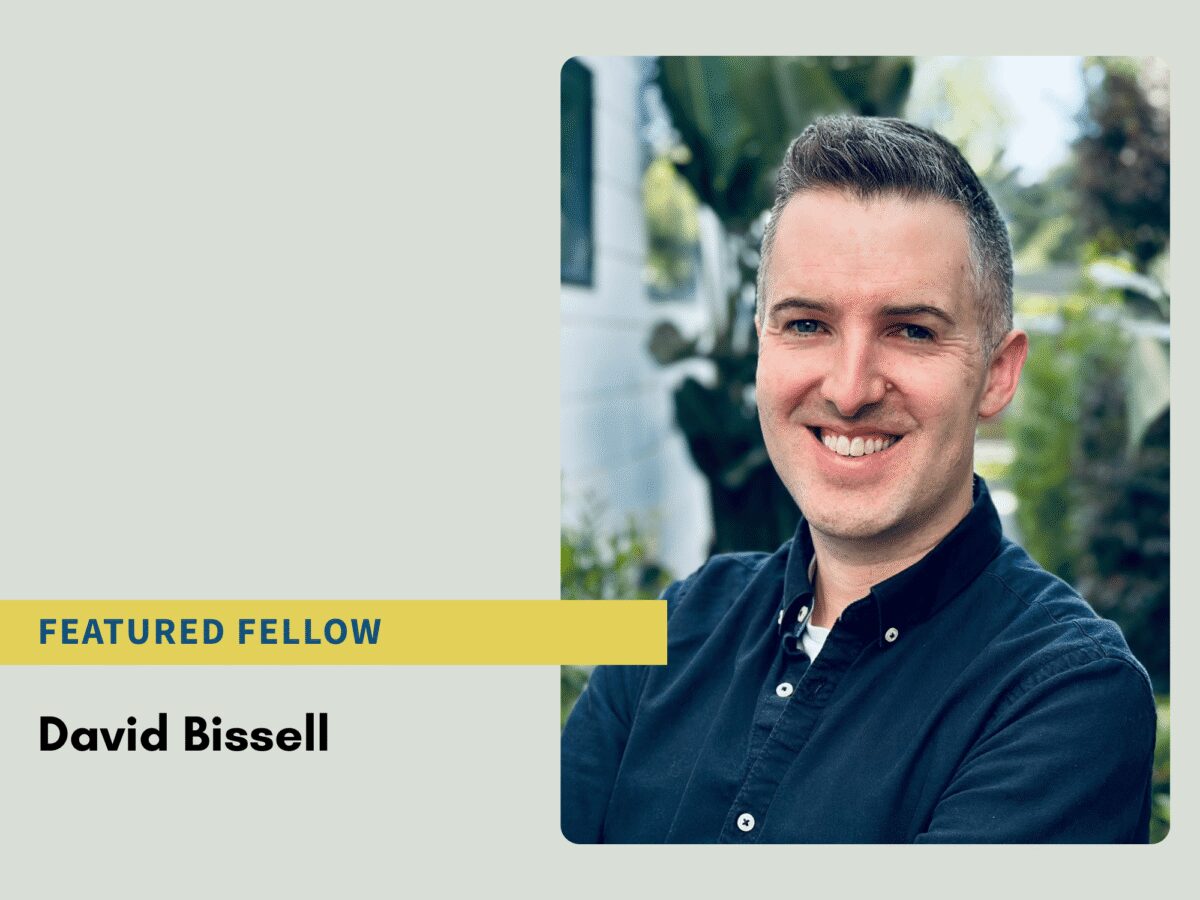
Professor David Bissell
Affiliation: School of Geography, Earth and Atmospheric Sciences, University of Melbourne
Discipline: Human Geography
Year elected: 2023
How would you describe your work at a dinner party?
As a geographer, I’m totally fascinated by how transformations in work, travel and housing are reshaping people’s lives in all kinds of unforeseen ways. A new project of ours is looking at how people are making decisions about work reskilling in parts of regional Australia. Rather than imagining people making cost-benefit decisions in isolation, as lots of policy tends to, we really want to understand how these decisions are intimately connected to the wider households and communities that people are a part of. As always, geography matters! And we want to figure out ways of making policies around reskilling more attentive to this vital place-based dimension.
What initially drew you to your field of study?
In my final year of undergraduate study, I took a subject in cultural geography, and it was truly lifechanging. For the first time, I started to understand how and why bodily experiences matter, and what this means for thinking about social transformations. Suddenly, thinking about the relationship between people and place became a really open-ended question and so far from the mechanistic and deterministic ways of thinking I was previously used to! From that moment on, grappling with question of how we transform places and how places transform us became a lifelong pursuit—and a pursuit I feel so lucky to have had the opportunity to undertake.
What continues to motivate your work?
It’s become somewhat customary to make a distinction between theoretical and applied work. But in doing so we risk forgetting that concepts have a reality. Concepts do things in the world: they change people’s capacities, they’re powerful, in fact, they are applied! I care about thinking and the real difference that concepts and the (often hard!) work of conceptualising makes in the world. I get so much pleasure from helping others in our school and beyond develop their thinking. At a time when it can feel that thinking is under threat (from technocratic managerialism, from macropolitical pressures, from large language models—the list goes on!), the art of building concepts is something that we should cherish and protect as social scientists.
What are you most proud of?
I’m really proud of being part of a discipline in Australia where people genuinely care about each other’s wellbeing and flourishing. Our annual Institute of Australian Geographers conference is, I think, a real testament to this intensely collegial and supportive ethos—and we’re also really very welcoming of non-geographers too! I’m also pretty proud of just about holding my academic life together and making sure that I balance that with ethical choices about giving my time and attention to the people in the world that really matter to me.