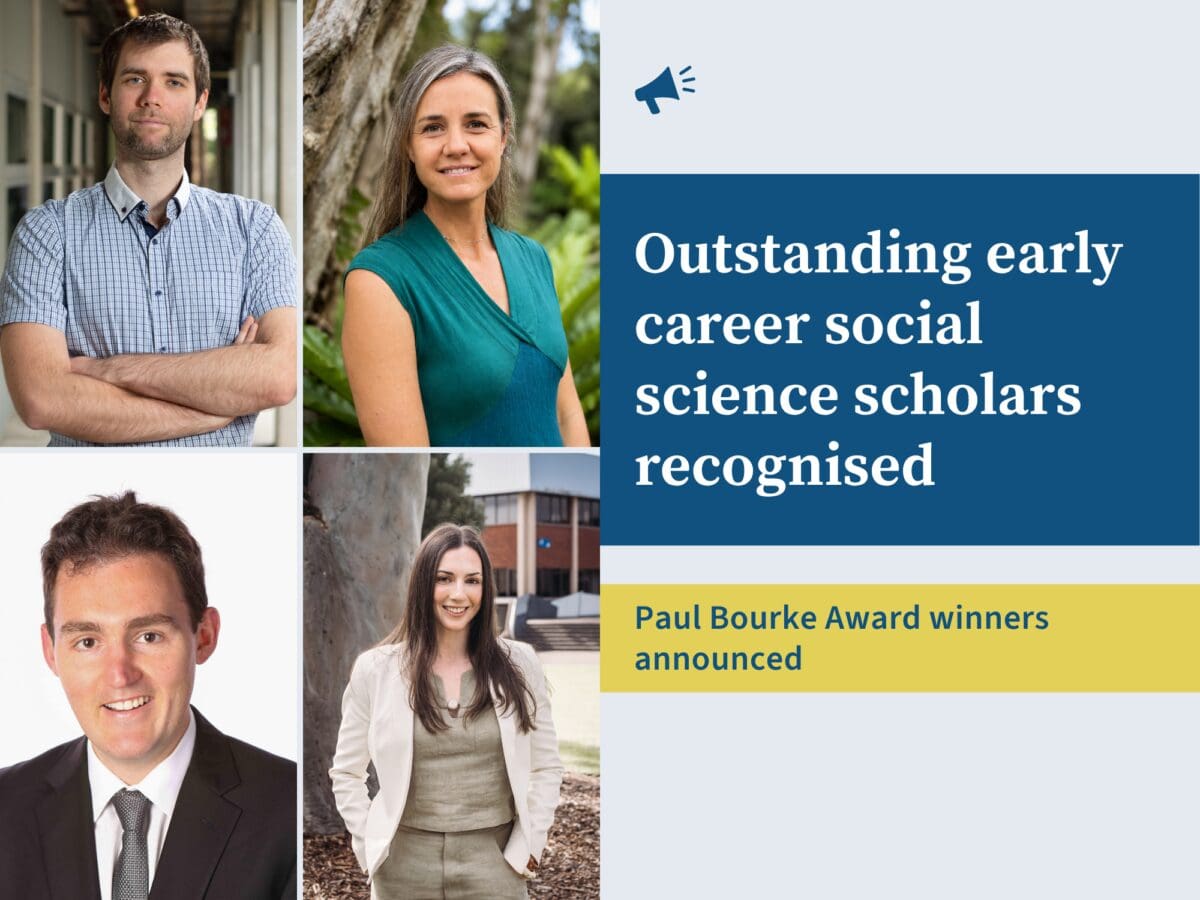
The Academy of the Social Sciences in Australia has announced the winners of the 2026 Paul Bourke Awards, recognising four of the nation’s most exceptional early career researchers in the social sciences.
Academy President Professor Kate Darian-Smith congratulated the awardees for their contributions across diverse disciplines and the role their work plays in advancing our understanding of complex societal issues.
“These four remarkable scholars are advancing knowledge in fiscal policy, women’s history, environmental governance, and PTSD treatment. Their innovative work is helping us better understand and solve real-world challenges, from improving trauma treatments to increasing cultural considerations in environmental management,” Professor Darian-Smith said.
“The Academy is proud to highlight these rising stars as part of our Social Sciences Week celebrations, and we look forward to seeing where their careers take them.”
The 2026 Paul Bourke Awards recipients are:
Dr Luke Ney
Dr Luke Ney is redefining experimental and clinical psychology by demonstrating critical limitations in the dominant fear conditioning paradigm used to model PTSD. His research shows that intrusive memories (central to PTSD) are better explained by stimuli occurring during, rather than before trauma, challenging a foundational assumption underpinning decades of research.
PTSD is a treatment-resistant disorder with high relapse rates and substantial socio-economic burden. Progress in treatment efficacy has been constrained by reliance on incomplete experimental models. Dr Ney’s research addresses this gap by demonstrating critical limitations in the fear conditioning paradigm underpinning exposure-based therapies, prompting a re-examination of how PTSD is conceptualised and treated.
Dr Ney is a Senior Research Fellow at Queensland University of Technology.
Dr Sarah Lawless
Working at the intersection of political ecology and environmental governance, Dr Lawless has reshaped how social justice principles are understood and operationalised across the institutions and policies governing social-ecological systems. With a particular focus on tropical coastal regions, she has developed practical frameworks to assist researchers, policymakers and practitioners to advance equity, rights and justice in fisheries, climate and conservation policy.
Dr Lawless is the first social scientist appointed by the Australian Institute of Marine Science (AIMS) as an AIMS@JCU Research Fellow, a significant milestone for social science in a natural science dominated field. She is building social science capacity through mentoring emerging researchers and supervising AIMS-supported postgraduate students. She has also worked closely with the AIMS Indigenous Partnership team, where she led the development of research and policy guidance on blue carbon and marine tenure rights.
Dr Lawless’ global advisory appointments include The Nature Conservancy, WorldFish, and CARE International, reflecting more than a decade of applied work in international development and marine governance.
Dr Lawless is an AIM@JCU Research Fellow – Ocean Governance at James Cook University.
Dr Christoper Hoy
Dr Hoy has generated new and important evidence on people’s preferences in relation to fiscal policy, fairness and redistribution in lower-income settings. Previous research had focused almost exclusively on higher income countries. Collectively, he has surveyed around 250,000 people in over 40 countries that are home to more than half of the world’s population. His work has challenged the perceived wisdom in relation to people’s preferences for fiscal policies, encouraging governments to be bolder in their reforms. This has resulted in the recent launch of the Policy Preferences Lab (Policy Preferences Lab), which brings together researchers from across six continents who are interested in understanding people’s attitudes to economic policies and how governments can design policies that are effective and publicly acceptable.
Dr Hoy’s research has involved close collaborations with policymakers throughout the Indo-Pacific. He has partnered with the World Bank, ADB, DFAT, as well as government and private sector partners to produce important policy relevant research. This includes having conducted the first randomized control trial in Australia’s closest neighbour, Papua New Guinea. Following the award of his PhD, Dr Hoy was recruited through the highly competitive World Bank Young Professionals Program– one of the most prestigious entry pathways in international policy. In 2025, he received the Sir Tony Atkinson Prize from the Society for the Study of Economic Inequality and in 2026, he was awarded the World Bank ECA Research with Impact Award.
Dr Hoy is now the McKenzie Postdoctoral Fellow at the University of Melbourne.
Dr Jessica O’Leary
Jessica O’Leary is a leading scholar of early modern global women’s and gender history.
Since PhD conferral in 2021 Dr O’Leary has transformed early modern global history by establishing women as central agents in diplomacy, empire and cross-cultural knowledge production. Across two books and seventeen peer reviewed articles and chapters, including in Past & Present and The Historical Journal, she has challenged assumptions that global exchange and diplomacy were driven primarily by elite male institutions, demonstrating instead how women enabled the circulation of people, plants, knowledge and power across cultural, environmental and imperial boundaries.
Dr O’Leary has held prestigious fellowships in Australia, Germany and Brazil, including the Harold S. Williams Fellowship at the National Library of Australia, a Max Planck Visiting Fellowship in Frankfurt, and a Junior Fellowship at the Maria Sibylla Merian Centre Conviviality-Inequality in Latin America at the University of São Paulo. Her research has attracted competitive funding from Germany’s Federal Ministry of Education and Research, the Renaissance Society of America, Veski–DAAD, Australia–Germany Joint Research Cooperation, Japan Past & Present, and the Japanese Studies Association of Australia, and supports collaborations across Europe, Latin America and North America.
Dr O’Leary currently works as a Senior Lecturer at Monash University.
For more information on the Paul Bourke Awards and previous winners, please visit: https://socialsciences.org.au/grants-awards/the-paul-bourke-awards/
About the Paul Bourke Awards
The Paul Bourke Awards for Early Career Research are named in honour of the Academy’s past president Paul Francis Bourke (1938–1999) who was a product of the History school at the University of Melbourne and went on to become one of the first Australian historians to obtain American style doctoral training.
Whilst at Flinders University, he served as Professor of American Studies and as Pro-Vice Chancellor. From Flinders University, he went on to become the Director of the RSSS at ANU and also served as the President of ASSA (1993-1997). The contribution Paul made to the field of performance measurement is invaluable by academic scholars.
Four Paul Bourke Award recipients are selected each year by members of the Academy’s Panel Committees. The awards are presented to social science researchers within five years of receiving their doctorate (with allowances for career interruptions).