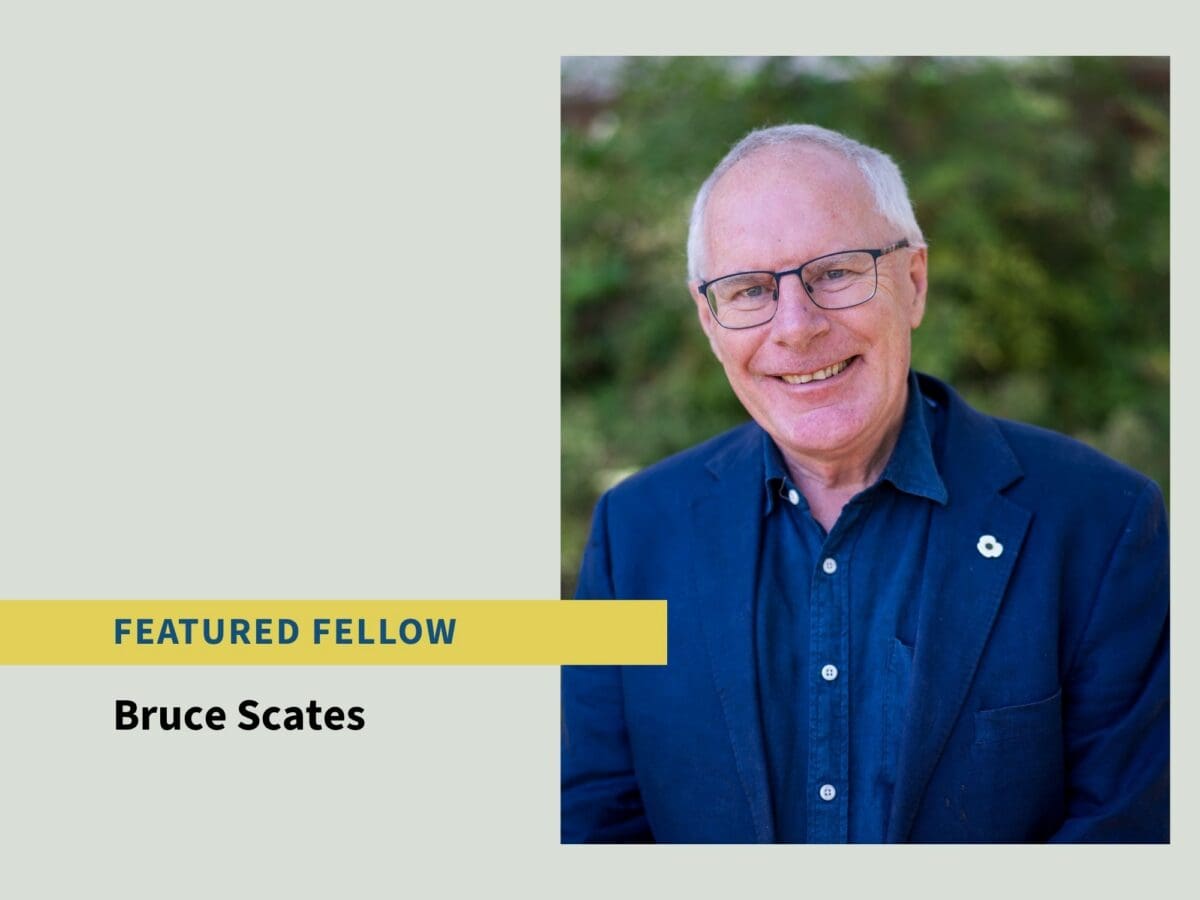
Emeritus Professor Bruce Scates
Affiliation: The Australian National University
Discipline: History, heritage and archaeology
Year elected: 2014
How would you describe your work at a dinner party?
My work centres on painful pasts and how we live today with their legacies. As a social and cultural historian, I delve into the archives to reveal stories of resilience and resistance, and seek to empower those often displaced and marginalised by history.
What initially drew you to your field of study?
The past shapes the world we live in and sets the trajectory of the future, so studying the past is a way of moving beyond it. A better understanding of the cost of war will help to avoid armed conflicts in the future, and alert us to the inequalities and injustices that have divided the world we live into insular and aggressive nations and empires.
What role do the social sciences play in your work?
My foundational training was as a labour historian and this has informed all my subsequent work. History is the one discipline that embraces all others so all the social sciences serve to enrich and shape my approach to the archives. Genuine learning is always a collaborative process, and I acknowledge my immense debt to all the Academy.
What question or issue, in your field, keeps you awake at night?
The way our universities have strayed from their urgent social mission and adopted a brutal and short-sighted corporate mentality in its place.
What should your field of study be doing more of right now?
I think we have to shift the drift of war commemoration in recent years. Anzac Day – and national institutions like the Australian War Memorial – have too often sanitised the cost of war, celebrating chauvinistic nationalism and promoting simplistic heroic narratives. Our task is to influence the cultural institutions and community groups that act as the arbiters of war memory promoting a more nuanced and inclusive approach to remembrance and acknowledging white Australia’s foundational war of Indigenous dispossession.
Tell us about a recent moment of motivation or inspiration?
The digitisation of World War One repatriation records has enabled families and communities to recover the post-war stories of the generation that suffered the Great War. It has helped foster a deeper understanding of the cost of war and the way it reaches into and damages the whole social fabric. Families have described the discovery of such records as a revelation, recovering voices often concealed by wartime service dossiers.
What continues to motivate your work?
The engagement of my students, the interest and support of my colleagues and the wider community, the moments of discovery I know await us all in the archives.
What are you most proud of?
In the lead up to bicentenary of the invasion of Australia, I worked with students, colleagues and most importantly Indigenous communities researching a statue celebrating a punitive expedition on the West Australian frontier to ‘avenge’ the death of white explorers. We mounted a case to local government exposing the history of provocation that led to these mens’ deaths, recounting the terrible violence visited on First Nation’s peoples and affirming the right of Indigenous communities to defend their sovereign lands. In the United Nations Year of Indigenous Peoples, a counter plaque was installed on the original memorial, anticipating the Statue Wars of recent years and setting a precedent of dialogical memorialisation.
What is your desert island book, song and/or movie?
A.S. Byatt, Possession: A Romance
Where is your ‘happy’ place?
A temperate rainforest, nestled in a valley in South East Gippsland, a place nurtured and cherished since time immemorial.