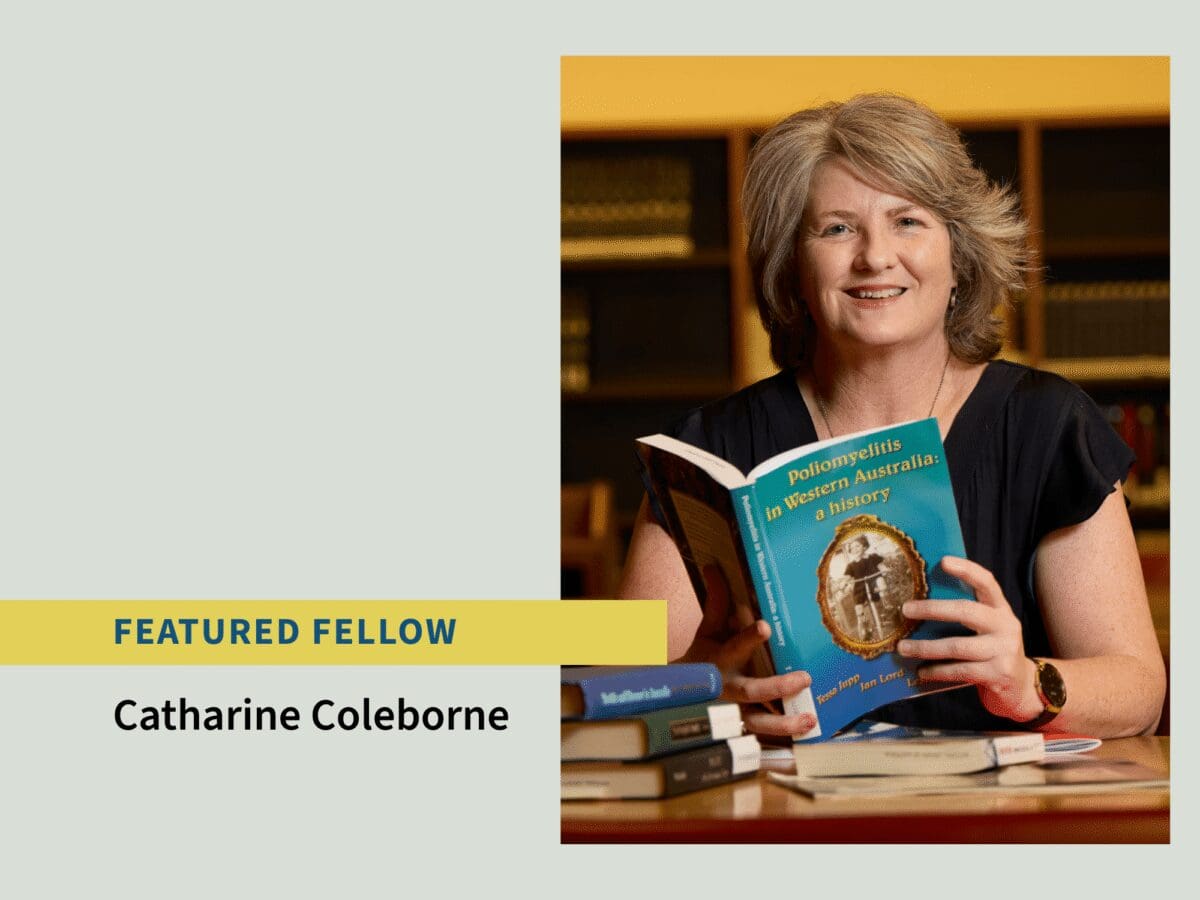
Professor Catharine Coleborne
Affiliation: University of Newcastle
Discipline: History, heritage and archaeology
Year elected: 2021
What initially drew you to your field of study?
There is something utterly fascinating for me about how we understand and make sense of illness in the everyday, how historians can interpret the mental and bodily ‘experiences’ of illness through clinical writings and personal, visual, or official documents. As an undergraduate I was initially drawn to the private lives of people as ‘sufferers’ of ill health who told their stories, but also to the practices of physicians who recorded their ideas about health and illness.
Tell us about a recent moment of motivation or inspiration?
In the past year I’ve been working on a new research topic, the history of poliomyelitis in Australia, especially through private memories in oral histories, and how these might link back to a larger, public story. I hypothesised that if I could find mentions of welfare organisations in oral histories conducted as part of special, institutional repository history projects, I might be able to trace connections and plot a narrative of polio that has been only partly examined. There are, of course, interesting existing memoirs, a couple of good, useful academic histories and scattered pieces of scholarship. Working in both the State Library of New South Wales and in the National Library of Australia during 2025, I have found new avenues of inquiry and have identified a whole new scale of possibility to tackle some of the silencesabout polio in the national story.
In the National Library during my Fellowship this year I had a tangible ‘discovery’ moment, and my historian senses went into flashing light mode!
What continues to motivate your work?
It depends when you ask me this question but today, I am motivated by the intrinsic value of intellectual inquiry. I strongly believe in research that has meaningful application and broader social implications. Yet we also need to foster a society that values ideas and curiosity in the past and its relevance to our present moment. I am struck by the importance of our national, state and local cultural institutions where so many people, including students, retired people, researchers, and professionals, seek and find spaces to inquire and ponder, to consider materials and to wonder about ‘things’. Libraries and archives, along with galleries and museums – and their role in the preservation of our national heritage -sit at the heart of a democratic society. They need to be celebrated, funded, and made accessible to all.