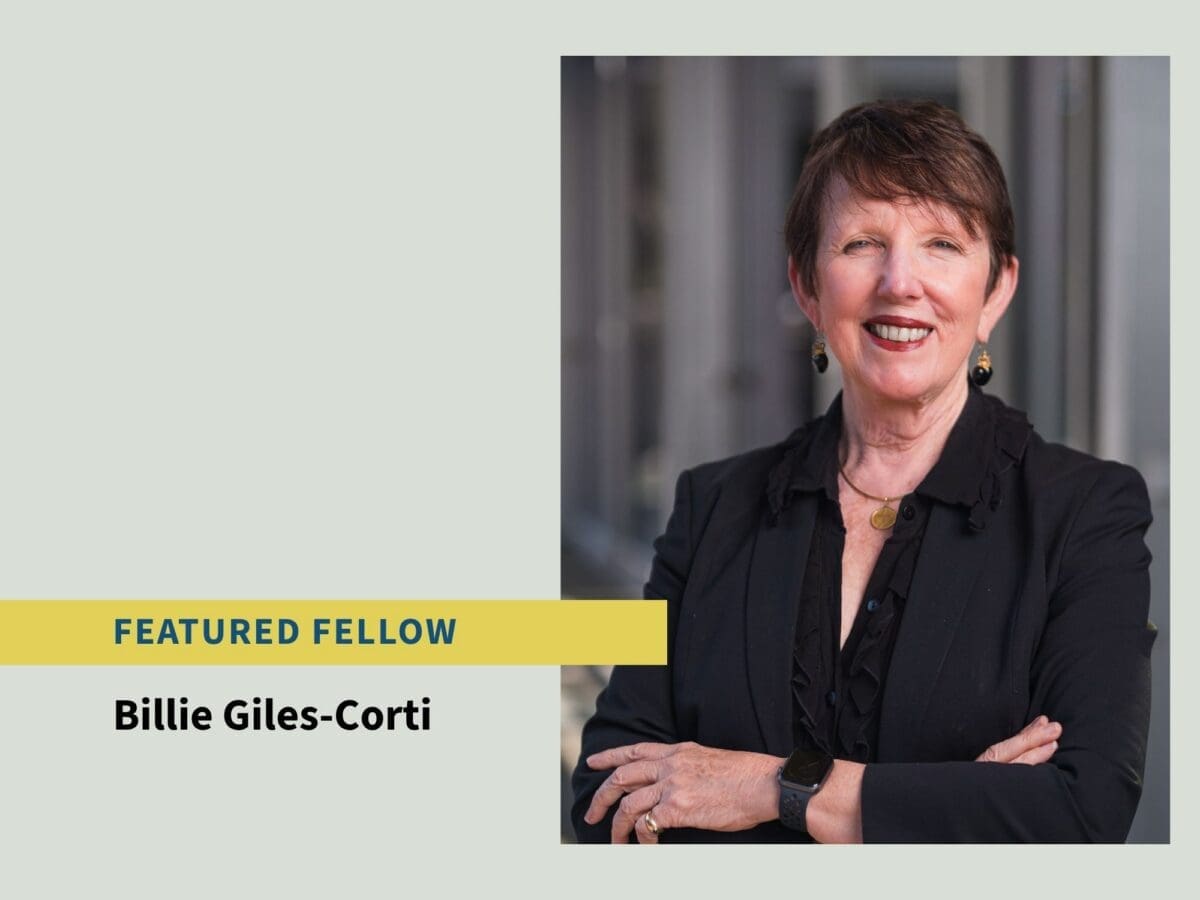
Professor Emerita Billie Giles-Corti
Affiliation: RMIT Centre for Urban Research
Discipline: Built environment and design
Year elected: 2023
How would you describe your work at a dinner party?
My research is about how to design cities to make people healthy.
What role do the social sciences play in your work?
The social sciences have underpinned my work: it has driven my research about what, why, when, and how city planning affects health and wellbeing.
What initially drew you to your field of study?
In 1986, the World Health Organization (WHO) released the Ottawa Charter that included five goals for health promotion to guide Member states. Two included the need to create: (1) supportive environments; and (2) healthy public policy. The latter was not about health policy: the idea that all policy should promote health. These goals captured my imagination.
I had worked in market research and knew how difficult it is to change people’s behaviour. I knew that a commercial company was ecstatic when it achieved a 1% market share; but the task of promoting health was more complicated: often people did not want to ‘buy’ your product (i.e., to give up smoking, to be physically active). Moreover, in public health, we wanted to change the whole population – a 1% market share was not enough: hence bringing about structural reform that would make ‘healthy choices, the easy choices’ – as was the mantra of the day.
Despite the appeal of the WHO goals, there was little evidence around at the time. So, in 1993, I enrolled in a PhD and embarked on a journey to explore how the urban and transport planning affects health and wellbeing.
What are you most proud of?
I am proud that our team was able to undertake high quality, cutting-edge research that ‘spoke’ to policymakers and practitioners. This was achieved by building strong trusted relationships with committed policymakers and practitioners, who gave us insights into the challenges they faced in trying to improve urban planning outcomes. As a result, many of our evidence-based urban design metrics have ended up in policy.
Nevertheless, policies are only as good as their implementation. So another proud moment was when we launched the Australian Urban Observatory, which took our geospatial data off our computers, by visualising evidence-based policy-relevant indicators, and made them available to stakeholders, so that they (and we) could benchmark and monitor the implementation of urban policies in Australia’s 21 largest cities. This concept has now been upscaled to the Global Observatory for Healthy and Sustainable Cities that currently involves over 300 collaborators in nearly 200 cities in 57 countries, with plans to upscale to 1000 cities.
Finally, a very dorky proud moment was when the Australian Government established a new field of research code ‘Urban Planning and Health’. After years of being on the fringe of multiple fields, it was a small win in 2022, to finally have our own code.
Tell us about a recent moment of motivation or inspiration?
I was thrilled that in December 2025, several members of our Global Observatory team travelled to Miami Florida to be awarded the 2025 Nobel Sustainability Trust (NST) Sustainability Award for Outstanding Research and Development for Intelligent and Sustainable Urban Solutions. This was important recognition of our work and helped motivate and inspire our hardworking team to keep scaling up to 1000 cities.
What continues to motivate your work?
This research has never been more important: growing urban populations; pressures on infrastructure and housing affordability, rising traffic congestion, air and noise pollution and energy and transport-related emissions and climate change are all related problems. The impact of city planning decisions on human, eco-system and planetary health is profound. Our city planning indicator work, is designed to provide feedback to policymakers about how well their policies are being implemented; and provide community and other stakeholders with independent evidence that can be used to advocate for policy and policy implementation change.
What should your field of study be doing more of right now?
Our field requires large multi-disciplinary teams. We need more research focused on the web of commercial determinants of city planning outcomes I.e., the commercial determinants of health; along with policy-relevant modelling work that helps explain why we are not achieving positive outcomes on-the-ground and how this can be rectified e.g., see Jafari; and multi-disciplinary research that creates virtual laboratories that can test policy options before they are implemented e.g., again see Jafari.
Importantly, these studies must involve and/or be driven by social scientists working in partnership with computer scientists as well as urban and transport planners. We need fewer studies that simply report urban problems; research that informs policymakers and practitioners how to fix those problems is needed.
What question or issue, in your field, keeps you awake at night?
What are the barriers to the uptake of research into policy and practice? Why does government fund research, but then not use it to inform better policy and practice? We see it in city planning, climate change and so many areas. If researchers are collaborating with policymakers and practitioners and designing policy-relevant research, why is it ignored?
What is your desert island book, song, and/or movie?
Wilfred Thesiger’s Arabian Sands, the best of Bob Dylan, and my feel-good movie, About Time.
Where is your ‘happy’ place?
Swimming, walking, cycling, skiing…and wandering around and observing cities. I am never bored. But also hanging out with my 3-year grandson…What a joy. He is the future, which is why this research is so important. I want to ensure he has a better future in cities.