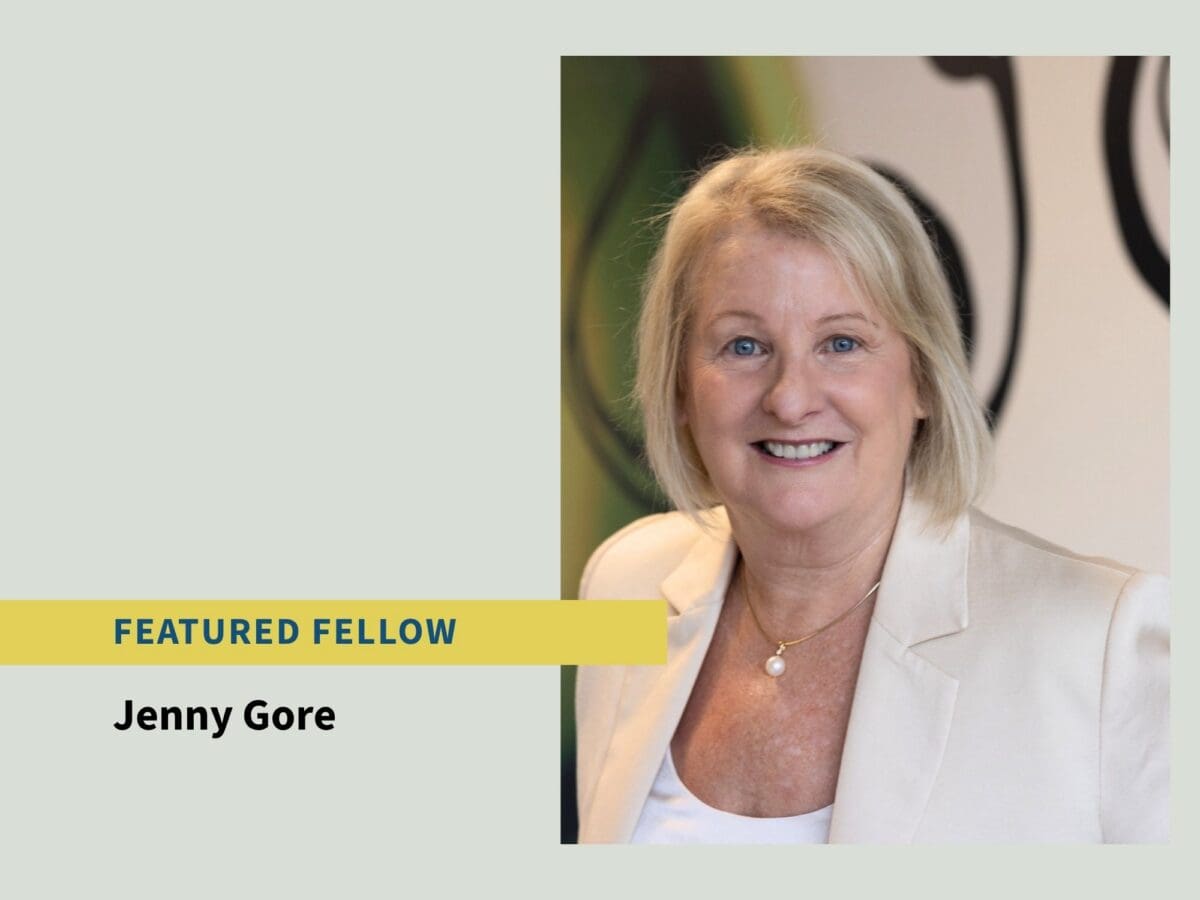
Laureate Professor of Education Jenny Gore AM
Affiliation: The University of Newcastle
Discipline: Education
Year elected: 2023
What initially drew you to your field of study?
I come from a family where teaching was common, especially among the women. Education was always around me. My deeper interests—how to get better outcomes for teachers and students, and how to make schooling more equitable—grew from being close to the profession. I could see that schools were being asked to do better, constantly. What was missing then, and often still is, was rigorous evidence about howthat improvement might actually happen.
How would you describe your work at a dinner party?
I usually say we build on what teachers already know and do. We provide clarity about good teaching and create conditions for teachers to observe and discuss one another’s lessons. It’s a deeply respectful way of working that values teachers’ professionalism. And it works—teachers feel more confident, more effective, and more likely to stay in the profession.
What role do the social sciences play in your work?
The social sciences are central. Social policy, sociology, psychology, and health all shape education. Together, they help us understand how schools work—and how best to support teachers and students.
What question or issue in your field keeps you awake at night?
Right now, it’s how to capture the attention of key decision makers, especially education ministers. They have extraordinary power to make a real difference for teachers and students, in line with stated goals of excellence and equity. Yet too often, decisions are shaped by politics, ideology, and media pressure rather than strong evidence.
What are you most proud of?
I’m most proud of the difference our work is making. Our approach to teacher development, Quality Teaching Rounds, is showing stronger teacher retention, higher efficacy, and improved morale. Importantly, it’salso making a real difference to student achievement, including more equitable outcomes. I’m incredibly proud of my team—none of this would have happened without them. Securing large philanthropic funding, which is rare in education, allowed us to build a whole program of research, not just a single project. And it’s been wonderful to see strong international interest, with projects in Sweden, Germany, and Scotland and interest from China, India, Japan, the USA, and Wales, among others, and PhD students studying the approach in places as diverse as Albania and Indonesia.
What continues to motivate your work?
Many challenges remain. Achievement isn’t where we’d like it. Inequity persists. Teacher attrition is a serious concern. These problems call for careful, rigorous research. At the same time, increased government intervention in schooling and teacher education brings both opportunity and complexity. There’s enormous potential—but also new terrain to navigate.
Where is your happy place?
The beach, without question. I love the sound of the ocean, the warmth of the sun, and the life happening in and around the water. There’s always something to see. I do remind everyone to cover up, though—I’vealready had a few skin cancers removed. Also, anywhere with my children. I have two beautiful grown-up daughters who live in Western Australia. Any time with them is pure joy.