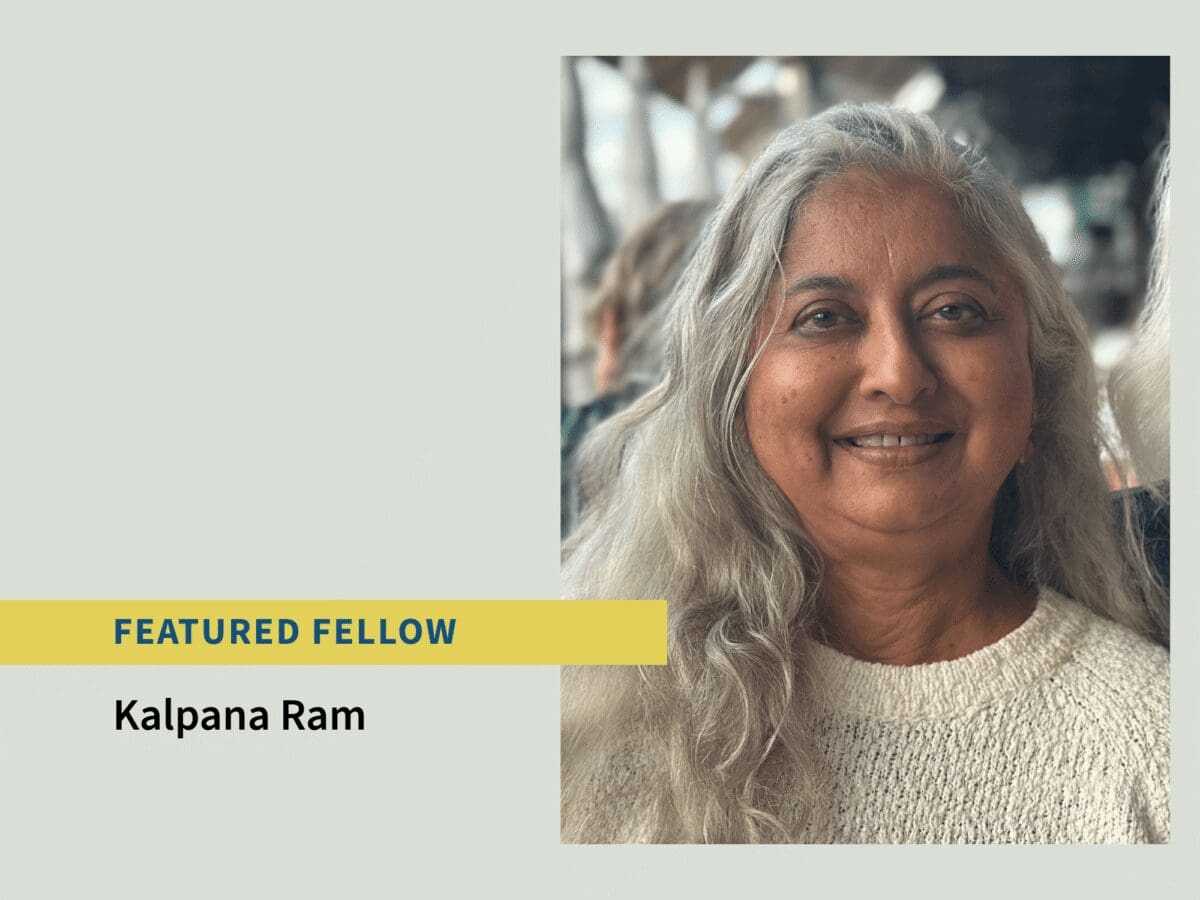
Professor Kalpana Ram
Affiliation: Australian National University
Discipline: Anthropology
Year elected: 2021
What initially drew you to your field of study?
Many of my answers about intellectual trajectory have their roots in my life journeys between India and Australia. I arrived in Sydney in 1971 from Delhi at the age of fourteen because of my father’s government posting as trade commissioner for India. I was raised in a family with many intellectuals who found jobs in branches of a newly independent Indian state trying to modernise but also decolonise itself in terms of an economy and politics genuinely free of western powers. The Australia I arrived in was experiencing a surge of social movements in the wake of the anti-Vietnam protests. Once at Sydney University in 1973 I was immediately drawn to the disciplines and students who were explicitly engaging with questions to do with racism, sexism, class, and finding coherent frameworks for a critical analysis of power. I did honours in Philosophy and Politics as a major. As a postgraduate, my urgent mission was to turn back to India to ask how such theories and critiques applied to my country. That became the principal field of study thereon, but I needed the social sciences for research tools better equipped for such research. I turned to Sociology for my Masters, but it was my PhD in Anthropology that was better suited – it gave the time and some of the methods it took to actually accomplish my goals which for me entailed moving out of my family’s privileged version of India and to learn from women in Dalit agricultural and fishing communities, and on their terms.
What are you most proud of?
I look back at nearly fifty years of work and realise I have produced high quality publications and taught in ways that have drawn on all the disciplines I have trained in. I have been able to transmit something of the excitement of learning with this breadth to a substantial cohort of postgraduate students here in Australia, but also to postgraduates and colleagues wherever I have gone in response to invitations: India, the U.S, U.K, Germany, Denmark. Thedoctoral scholars at Macquarie University and ANU have taken my work on India in many exciting directions, creating a substantial body of work on women’s health, the concerns and creative responses of low-status communitiesfrom Adivasis (indigenous communities) to rural transgender communities, always working with communities on the ground. To give my postgraduates a taste of a wider research culture for a few years I directed an India Research Centre. All this, without a real research culture of South Asian studies in this country.
I only realised what was missing when I began travelling to speak or teach at major universities of U.S and U.K from the 1990s onwards. By contrastwith them, Australia has performed very poorly in funding and sustaining university appointments and research on India. While this now makes me reflect on the real extent of my achievement, the wider implications are grave. We have run down even the level of knowledge of India among Australian scholars that was there when I first began my work, where I met academics, admittedly few in number, but who had spent extensive periods of time there, loved India, and had Indian colleagues who appreciated their work and contribution. Their postgraduates found no jobs where they could teach on India, and continuity of transmission was lost. At a time when India is being recognised as an economic and political power that increasingly needs to be reckoned with, we have lost that knowledge bank of qualitative depth of understanding only out of which applied responses can arise.
What continues to motivate your work?
I seek to resist the huge pressures these days to simplify what are complex realities. The worlds of marginalised communities far exceed modern discourses such as development, aid, or even activism. When I first began research, I was enough of an activist to feel disturbed by the question of the immediate usefulness of my writing. I could see how my work was questioning the limits of many western academic models – but how did that help the fishing community I was writing about? To make matters worse, some community members themselves quizzed me about this when I was doing doctoral research in the ‘80s.
But over the years, their children and grandchildren have become educated, and many have found and read my books. They write and tell me how incredible it is to find their communities’ lives and histories in print, to be able to read and to share with their parents. They also use it to reflect more widely on the social forces that have shaped their realities – a perspective they are gaining from a broad social science theoretical and descriptive framing, since it is not given by daily experience alone. This longer-termunderstanding and affirmation from ordinary people helps me to affirm and motivate other researchers as well. There is a value, beyond what we can immediately perceive, in our books when they strive to expand dominant definitions of reality and in imaginative rich writing – precisely because we cannot anticipate all the different ways in which they will be read, appreciated, and employed by diverse readerships over time.
What role do social sciences play in your work?
What I teach my students and try to model in my writing and publications is that qualitative, engaged, participatory research is vitally needed if we are to go beyond two ways in which cultural difference typically gets framed. The first is to see cultural differences as deep but impassable, which leaves no opening. The second, more prevalent version is the institutional acknowledgements of ‘diversity’, but often to tame difference, to keep it at arm’s length to be better managed or made safe for consumption.
Anthropology has played its own part in this colonial epistemic landscape, but what I have come to value is the opening it also keeps alive – provided we are prepared to go through it as a humble apprentice, not as a knower and an expert. This is a very different existential orientation and resembles a child’s way of coming to know its world in the first place except ours is a secondary socialisation and will always be shaped by our primary one. There is immense value in teaching this to students. Given also how many students are themselves from immigrant backgrounds, following this path opens routes that are not simply between a west and a non-west. My students of Indian background undertaking work of this kind have found it to be a transformative bridge back to the land their parents and grandparents come from, but widening it beyond their family’s perspectives, often with life- changing consequences.
What question or issue, in your field, keeps you awake at night?
The scale of destruction we are currently experiencing of human and non-human life, as well as of the very matrix of elements that sustain life. Turning this around is a matter of collective effort, but we have a particularly urgent responsibility as social researchers to use the luxury we have been afforded, of time to think, teach and research to use the crisis itself as a spur to re-think our paradigms. For too long anthropology and sociology have spoken only of human societies, as if they had little to do with the wider networks of life forms or the quality of soil, air, water. Multi-species ethnographies and environmental humanities are welcome signs of a more holistic framework and finally, we are starting to explore the ‘more than human’ basis of our human world.
I would urge us not to fall back into technocratic solutions and language but to keep the most imaginative frameworks at our disposal, many of which are available precisely in parts of the world and among populations most affected directly by climate change and the legacies of colonialism and ongoing capitalist destruction. We only have to think of the radical re-definition of ‘land’ afforded to us by our First Nations peoples who see it as ‘Country’ that cannot be owned, only cared for by those whose very social identity is conferred by that act.