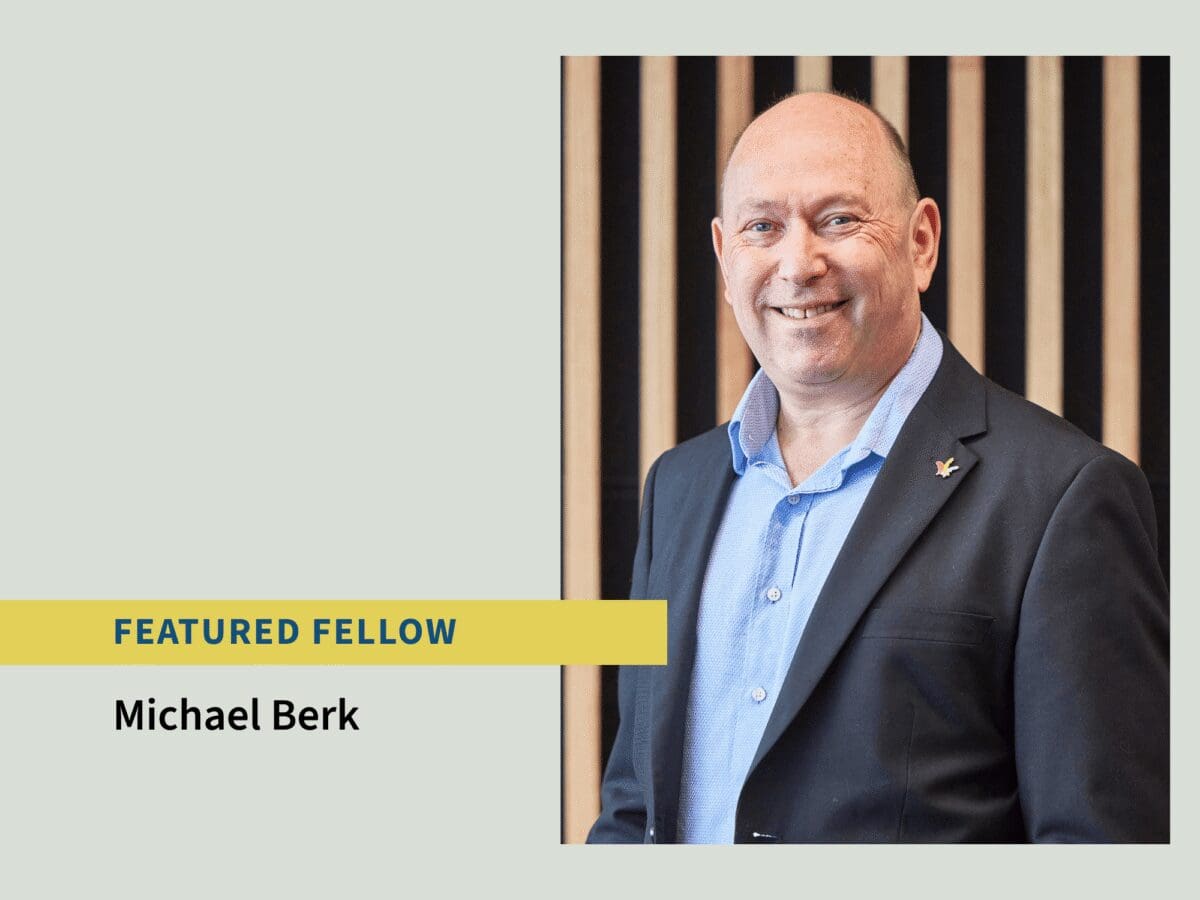
Professor Michael Berk
Affiliation: Institute for Mental and Physical Health and Clinical Translation
Discipline: Health Sciences
Year elected: 2021
How would you describe your work at a dinner party?
I work on developing novel treatments for mental health problems. Most recently, to bypass the lack of an established pathophysiology, we have worked with stem cell experts who have developed stem cell models which allow us to repurpose medications that might work for mental health problems.
What initially drew you to your field of study?
I was drawn to research by inspirational mentors who installed a love of the generation of knowledge and the curiosity to understand the underpinnings of mental health problems in order to better tackle them.
Tell us about a recent moment of motivation or inspiration?
The stem cell models that our partners have developed have given us a series of lead compounds which we have been able to take into clinical trials that might be useful for disorders like depression bipolar disorder and schizophrenia. These have allowed us to examine molecular targets that have not yet being evaluated as treatment approaches such as mitochondrially targeted therapies. Mitochondria are the organelles that generates energy inside cells. We have been able to take potential mitochondrial agents into clinical trials of bipolar disorder and most recently chronic fatigue syndrome.
What should your field of study be doing more of right now?
I believe that convergence science approaches are necessary to solve the complex issues of the non-communicable and particularly mental health disorders. This is the cross pollination between superficially unrelated disciplines which leverages the skills and approaches of complementary fields which allows a deeper understanding and is better suited to develop solutions for complex multi systemic problems for which single discipline approaches have not been effective. The social sciences are a keystone approach in this matrix.
What are you most proud of?
I am most proud of the kinds of research, invariably clinical trials, that support novel treatments for neglected mental health problems. The bad news is that we have many unmet needs, but we have been fortunate enough to have a few treatments that we have worked on enter routine clinical care.