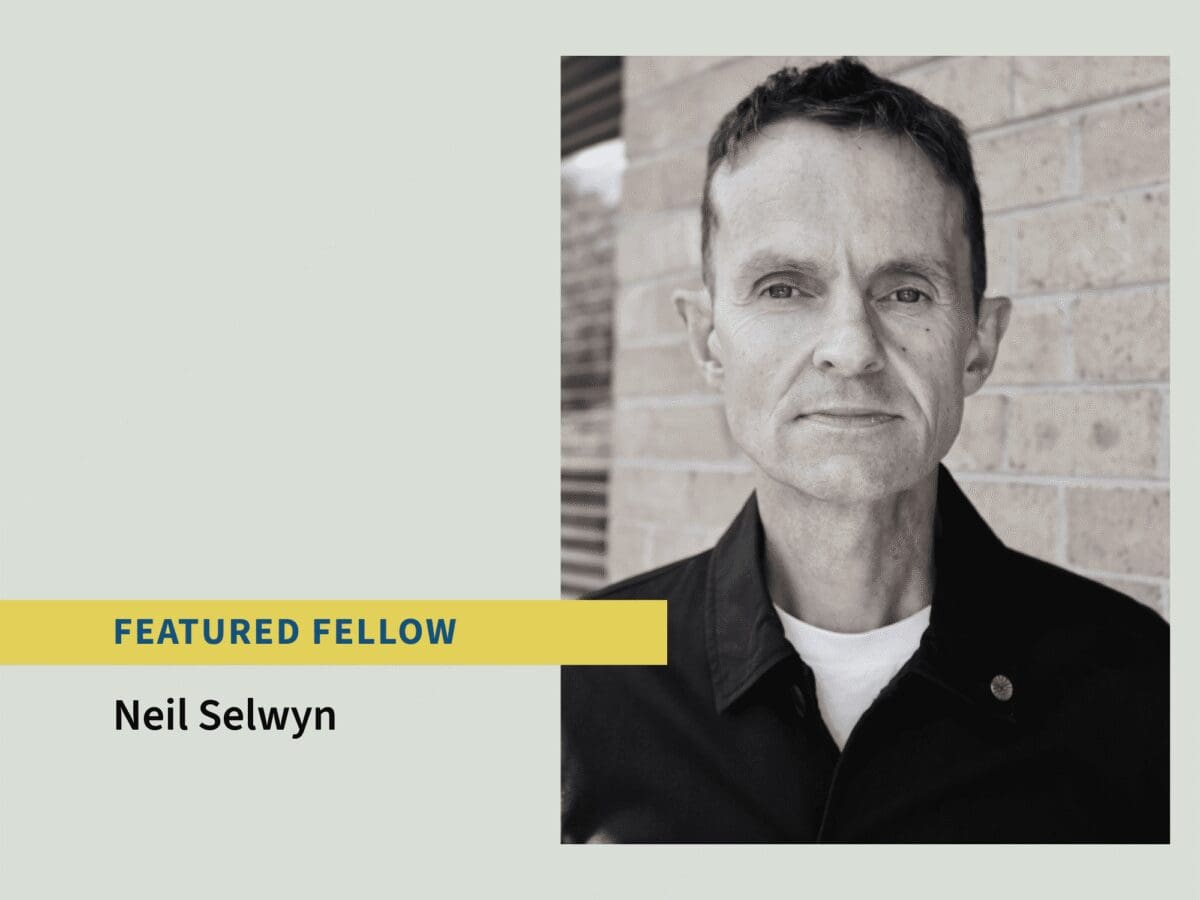
Professor Neil Selwyn
Affiliation: Monash University
Discipline: Education
Year elected: 2024
What initially drew you to your field of study?
I was always interested in the sociology and politics of education. So, when I was pitching for a PhD scholarship back in the 1990s, the educational uses of computers and what was beginning to be referred as the ‘information superhighway’ seemed like under-researched topic areas that might be fundable and have a bit of relevance for a few years …
What continues to motivate your work?
As it turned out, digital education as a research area has refused to die down over the past 30 years, meaning that there has been an endless succession of purported digital ‘transformations’ of education that require critical scrutiny. The current hype around GenAI and the social media ban are just the latest in a long line of technological developments to motivate my work … I am sure that there will be more to come!
What role do the social sciences play in your work?
Digital education is an area of policymaking and practice that is increasingly dominated by claims of ‘what the science says’ – predominantly looking toward neuroscience, cognitive psychology and a distinctly medicalised approach to evidence. My research community is trying hard to ensure that social science is included in these conversations as a valuable and valid form of ‘evidence’. Social scientists need to be loud and proud about their capacity to provide unique contextualised insights into the ways in which digital technology is reshaping everyday education.
Tell us about a recent moment of motivation or inspiration?
For the first half of 2025 I had a paid secondment to work at a university in Sweden, which gave me plenty of motivation to get to grips with familiar research problems in a less familiar social, cultural and political context. It was also inspiring to be back in a European research mode and be able to get over to Copenhagen, Warsaw, Oslo and other places for work and not feel physically exhausted and environmentally guilty.Australia is a great place to be based as social scientist, but it was nice to (temporarily) be less bound by time and distance.
What should your field of study be doing more of right now?
There is now a fast-growing critical literature on digital education, but while we are good at problematising the forms of technology currently being foisted into schools, colleges and universities, we are far less successful at pointing to plausible alternatives. If we don’t like the current flavour of ‘Big Tech’ and AI being pushed by the likes of Sam Altman and Bill Gates then what do we want?