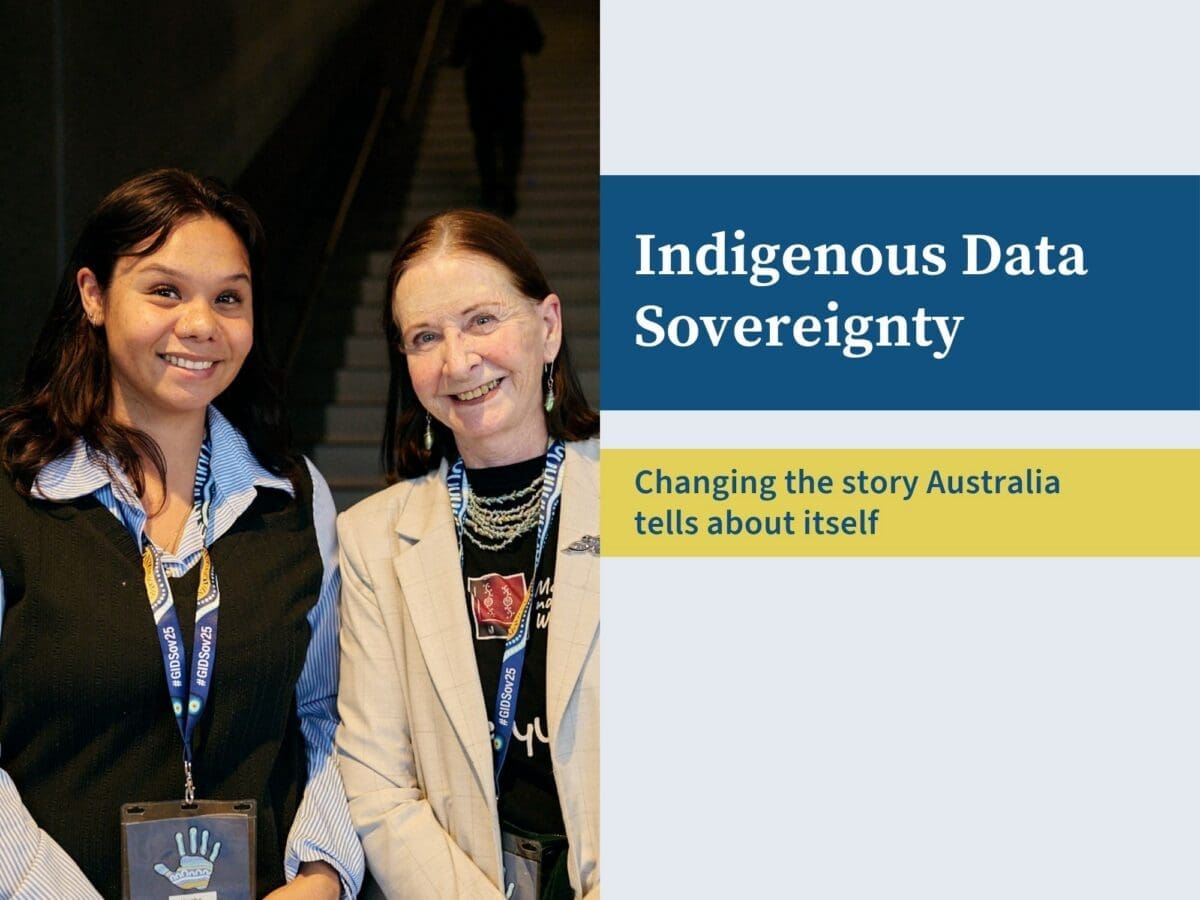
Pictured above: Kiesha Wear (left), Coordinator of Data Sovereignty at Wungening Aboriginal Corporation and Distinguished Professor Emerita Maggie Walter FASSA at the 2025 Global Indigenous Data Sovereignty (GIDSov) Conference. (Image credit: Wolflab Media)
For decades, Aboriginal and Torres Strait Islander peoples have been among the most counted populations in Australia, and among the least heard. Governments have collected mountains of statistics about Indigenous lives: rates of smoking and drinking, attendance at school and rates of arrest, illness and incarceration. What those numbers have rarely capture is context, cause, or culture. According to Palawa sociologist and Academy Fellow Distinguished Professor Maggie Walter, that imbalance isn’t accidental. “The data tells a story of inadequacy,” she says. “It says we are to blame for our own problems.”
The Indigenous Data Sovereignty movement emerged as a collaborative effort by Indigenous academics around the world to reclaim control over how data about Indigenous peoples is collected, interpreted, and used. While the term itself is relatively recent, its foundations reach back long before spreadsheets and surveys. Prior to colonisation, Aboriginal and Torres Strait Islander peoples governed knowledge through complex systems of cultural authority. Colonisation disrupted those systems, replacing them with British administrative practices that transformed Indigenous peoples from knowledge holders into data subjects.
The modern movement took clearer shape in the mid‑2010s, catalysed by a 2015 workshop funded by the Academy of the Social Sciences in Australia that brought together Indigenous scholars from Australia, Aotearoa New Zealand, Canada, and the United States. Professor Maggie Walter describes the workshop as deliberately rigorous, with participants required to write their chapters before they arrived. “This wasn’t a roundtable or a chat,” Maggie recalls. “The term Indigenous Data Sovereignty hadn’t been coined yet but everyone in the room had been working in this space and understood what was needed to improve Indigenous rights to data.”
That scholarly groundwork mattered. It meant the conversations could move quickly from definitions to relationships; from critique to strategy. It also highlighted something fundamental: Indigenous data looked similar across settler colonial nations. Whether Māori, First Nations, Native American, or Aboriginal, the same pattern persisted – data dominated by deficit, stripped of explanation, and framed to serve government priorities rather than Indigenous wellbeing.
Maggie describes this as the tyranny of “what” questions. How much do you smoke? How often do you drink? How many days did your child attend school? What’s missing are the “why” question about racism, safety, institutional failure, and social environment. One example Maggie shares to demonstrate this approach is the Australian Government’s Longitudinal Study of Indigenous Children (LSIC), commencing in 2008 and involving1,200+ children and their families. When Maggie and her colleagues investigated the LSIC data they found that commonly cited factors like poverty or family structure explained only five per cent of children’s wellbeing status. When questions about safety, bullying, and school environment were added, explanatory power jumped to more than fifty per cent. “The answers they don’t want,” she says, “are always about institutions, not Indigenous people.”
Maggie and her Australian collaborators including Professor Ray Lovett, Dr Vanessa Lee-Ah Mat and Professor Gawaian Bodkin-Andrews formed the Maiam nayri Wingara Indigenous Data Sovereignty collective in 2017. One of its first strategic decisions was to refuse government funding. “That meant freedom,” Walter explains. “Freedom to critique, to speak plainly, and not be captured.” Another was to “write the canon”, to publish foundational texts so thoroughly that searches for Indigenous data sovereignty would lead back to Indigenous scholars themselves. Today, that strategy is so successful that the term appears everywhere, from policy documents to corporate framework, often copied verbatim, sometimes without acknowledgement.
The widespread uptake of the term Indigenous Data Sovereignty is both a victory and a warning. As Maggie notes, Indigenous concepts are frequently absorbed, diluted, and redeployed as platitudes. To prevent that, the movement has guarded access carefully. Indigenous‑only workshops in 2018 and 2023 brought together scholars, community leaders, and organisations to co‑design principles and practices for Indigenous data governance, the operational arm of data sovereignty. A global Indigenous Data Sovereignty Conference held in Australia in 2025–10-years on from the initial Academy-supported workshop–brought together 280 Indigenous people from around the world. After two days of discussion, non-Indigenous stakeholders and allies were invited into the room to talk about how Indigenous Data Sovereignty principles could be better embedded into administrative systems and research practices on local and national scales.
Those gatherings provided something academia alone could not: authority grounded in community.
The distinction between data sovereignty and data governance matters. Sovereignty names the rights of Indigenous peoples to have authority over data about their peoples, lands, and resources. It is grounded in the United Nations Declaration on the Rights of Indigenous Peoples. Governance is how that right is enacted through protocols, institutions, and accountability. Without governance, argue Maggie and her colleagues, sovereignty remains abstract. Without sovereignty, governance becomes tokenistic.
The decade since that first workshop have not been without their challenges for Maggie and the other members of Maiam nayri Wingara. “Public servants often respond with blank stares when I talk about the ‘ontological chasm’ between two very different ways of seeing, and measuring, the world,” she explains. The work has also been met with resistance by some statistical agencies who claim neutrality, insisting “the data is just the data.” Maggie says it can be exhausting constantly explaining why numbers are never neutral. “What is counted reflects what, and who, matters. When data are used to endlessly demonstrate disparity without explanation, it doesn’tsimply describe inequality – it helps to create it.”
For Maggie and her international collaborators, the challenge is ensuring Indigenous peoples remain in charge of this conversation. “Colonisation never sleeps,” Maggie says wryly. For Indigenous data advocates, the goal is not fewer numbers, but better ones. As Maggie says, “we do this work to ensure data provides a more complete and accurate picture of Indigenous peoples and better supports stronger, more informed decision-making.”
Definition of Indigenous Data Sovereignty from The Maiam nayri Wingara Indigenous Data Sovereignty collective website
The right of Indigenous Peoples to exercise ownership over Indigenous Data. Ownership of data can be expressed through the creation, collection, access, analysis, interpretation, management, dissemination, and reuse of Indigenous Data (Kukutai & Taylor 2016; Snipp 2016).
This is an internationally recognised and endorsed definition that cannot be changed even when summarising or paraphrasing.
Read more stories from Socium magazine, Volume 1, 2026.