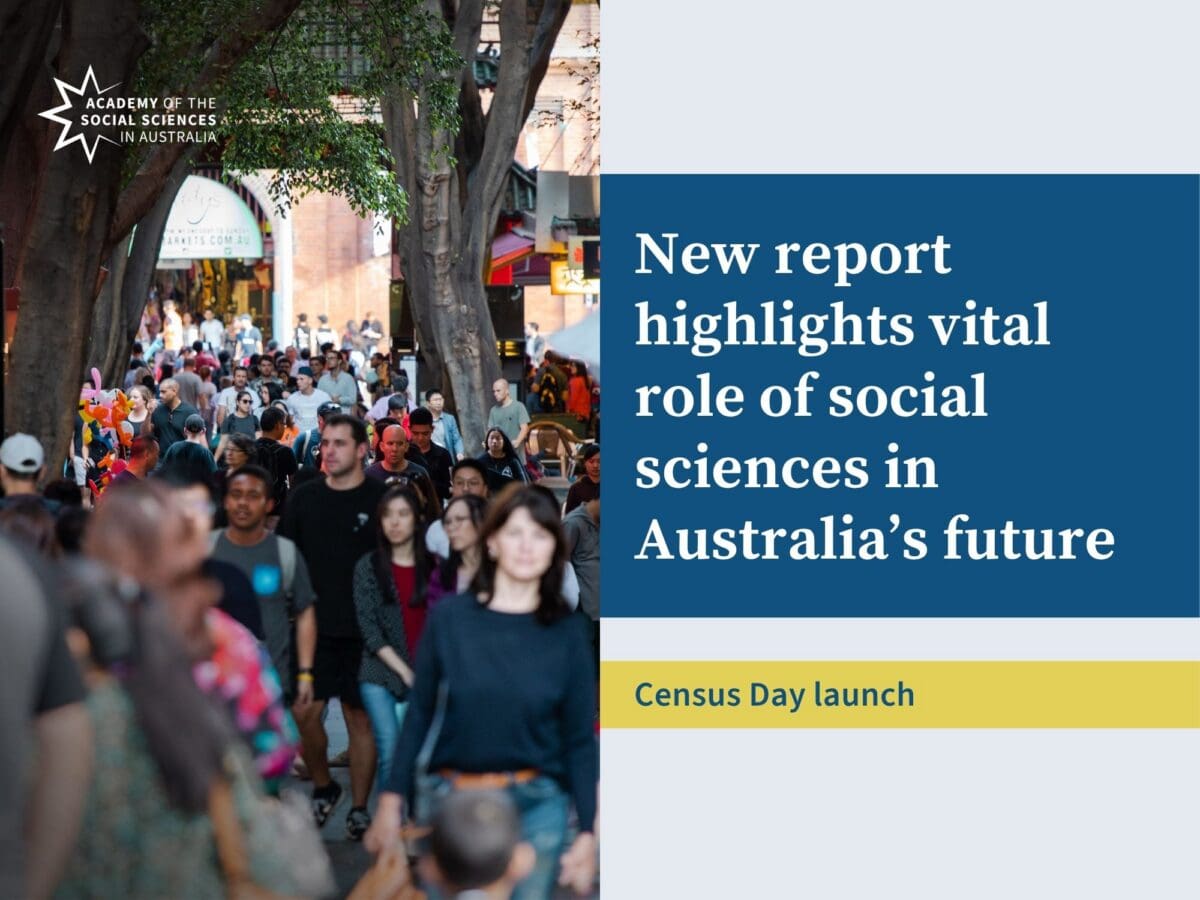
The Academy of the Social Sciences in Australia today launched its landmark Social Sciences for Australia’s Future report, calling for renewed investment in education, research and capability-building to ensure Australia can meet the complex challenges of the decades ahead.
Released on Census Day, the report provides a comprehensive snapshot of the strengths, challenges and opportunities facing Australia’s social sciences across schools, vocational education, higher education and research. The report found that social sciences are driving Australia’s economic and social capacities. One-third of the Australian workforce has a social science qualification, including in occupations of current and projected need. Social sciences training and education is critical, with 51% of university and 43% of vocational education and training enrolments in the social sciences.
The report is based on extensive consultation with stakeholders from across the sector and was overseen by a steering committee of Academy Fellows and leading experts. It highlights excellence, identifies opportunities, and sets out priorities to strengthen Australia’s social science research, education and workforce capability.
Academy President Professor Kate Darian-Smith said the timing of the launch was significant.
“Census Day is a reminder that understanding Australia requires more than counting people. We need the insights, evidence and expertise of the social sciences to understand how Australians live, learn, work and connect with one another.”
“From productivity and democratic resilience to education, health, economic participation and social cohesion, the social sciences help governments, businesses and communities make better decisions. This report demonstrates why strong social science insights and skills are essential to Australia’s future prosperity and social wellbeing.”
Professor Darian-Smith said Australia’s capacity to respond to rapid technological, demographic, environmental and geopolitical change depends on understanding people as well as systems.
“The challenges facing Australia are increasingly complex and interconnected. Whether we are addressing climate adaptation, artificial intelligence, or economic transformation, social science knowledge is essential to designing effective, practical and equitable solutions.”
“This report makes a clear case for placing social sciences at the centre of national conversations about Australia’s future.”
The launch was hosted at Parliament House by the Parliamentary Friends of Social Science and attended by leaders from government, universities, research organisations, professional associations and industry. The report provides a roadmap for strengthening the contribution of social sciences to ensure a better Australia for future generations.
Report website: www.socialsciences.org.au/future